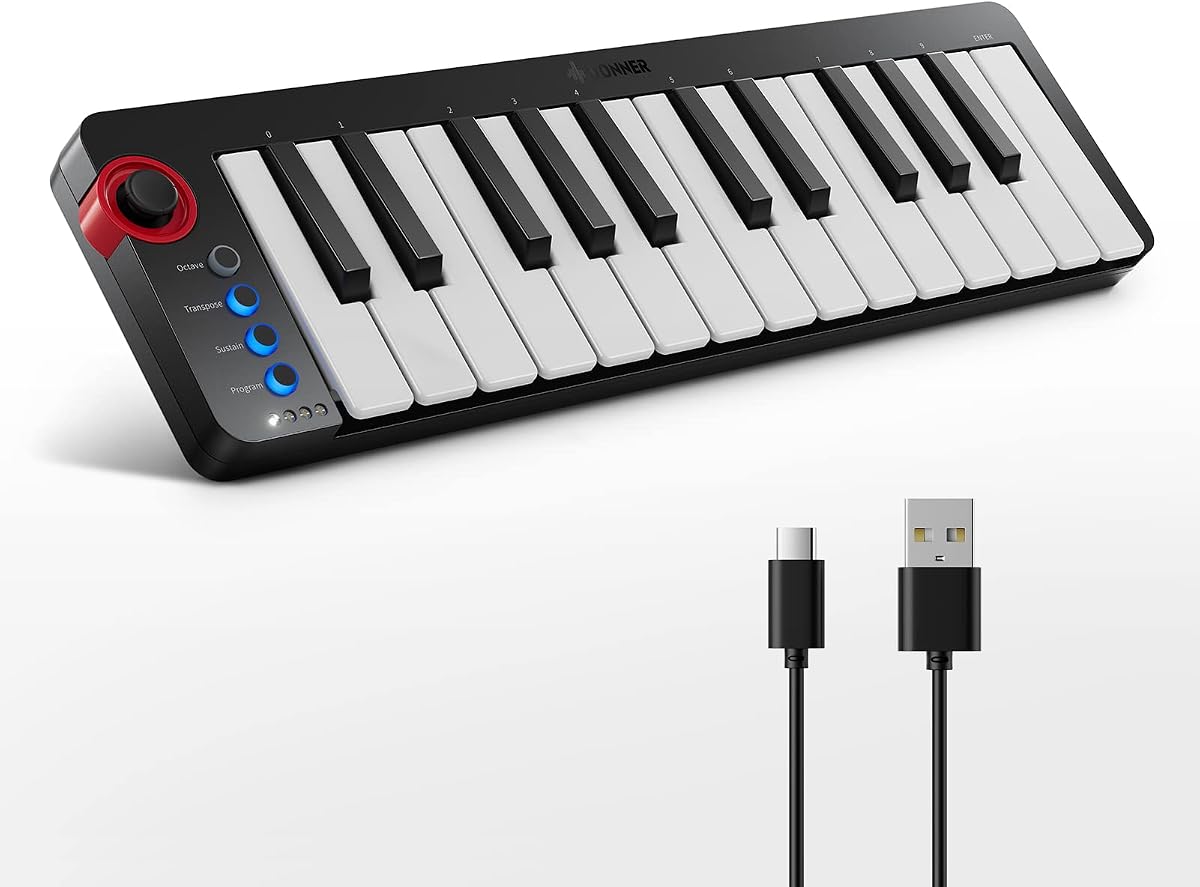
Donner Mini MIDI Keyboard N-25
4.1Editor score
Velocity sensitive mini keys
Light up rocker buttons
Includes 40 teaching courses
Explore our expert guide comparing the top 25 Key MIDI Controllers for 2026, covering features, compatibility, and performance for producers and musicians.
Finding the right music production tool can transform your creative process. A compact 25 Key MIDI Controller offers portability without sacrificing essential control over your virtual instruments and software synthesizers. Whether you are sketching melodies on the go or managing a home studio setup, these devices provide the tactile interface needed to bring your ideas to life efficiently.
We evaluated leading models based on key response, software integration, build quality, and included bundles. Our analysis focuses on how each controller handles velocity sensitivity, octave shifting, and connectivity options like USB or Bluetooth. We also considered the value of included DAW licenses and sample libraries to ensure you get maximum utility from your investment in music hardware.
Each pick below highlights specific strengths for different workflows, from budget-friendly beginners to seasoned professionals. Detailed reviews cover performance nuances and real-world usability scenarios. Please note that pricing and availability fluctuate frequently, so verify current costs before making your final purchase decision for the best deal.
4.1Editor score

4.6Editor score

4.5Editor score
This side by side comparison highlights the core specifications and unique selling points of each model to help you visualize the differences in size, features, and connectivity options available across the market.


The Novation Launchkey Mini 25 MK4 stands out as a top tier choice for producers seeking a balance between portability and deep functionality. Its high rating reflects strong performance in handling complex workflows with ease. The controller features a premium keybed that offers a satisfying tactile feel for intricate melodic work.
We may earn a commission when you buy through this link, at no additional cost to you.
Its standout feature is the seamless integration with major digital audio workstations allowing for intuitive mapping and control without extensive setup. The 16 FSR pads are highly responsive and support polyphonic aftertouch, enabling nuanced drum programming and expressive sound manipulation. This level of control is rare at this price point.
While the unit is slightly larger than ultra compact models, the extra footprint allows for more physical controls like dedicated transport and navigation buttons. The included software bundle provides significant value, offering production tools that might otherwise require separate purchases. These trade-offs are minor compared to the overall utility.
You should buy this if you need a reliable controller that grows with your skills and supports professional production standards. It is ideal for users who prioritize software integration and want a device that feels like a true extension of their DAW environment.
The FSR pads allow for detailed velocity and pressure control enhancing your ability to create dynamic drum patterns and trigger clips effectively.
Comes with Ableton Live Lite and other tools ensuring you have everything needed to start producing music immediately upon unboxing.
We may earn a commission when you buy through this link, at no additional cost to you.
The Akai MPK Mini Play MK3 is unique because it functions independently of a computer thanks to its internal sound engine and built-in speaker. This design makes it perfect for sketching ideas on a bus or in a location without power. It maintains the high quality construction expected from the MPK series.
We may earn a commission when you buy through this link, at no additional cost to you.
It includes over 100 internal instrument sounds so you can compose tracks using only the hardware. The OLED display helps navigate menus easily while the included software bundle extends its capabilities when connected to a DAW. This dual functionality offers versatility that few competitors can match.
The internal speaker is convenient for quick playback but lacks the depth of a dedicated audio interface. However, this is acceptable given the portability and standalone focus of the device. It remains a robust tool for both practice and professional production workflows.
Choose this model if you want the freedom to create music anywhere without carrying a laptop or tablet. It is especially suitable for beatmakers and songwriters who need a self-contained unit for inspiration and quick sketching.
Power it with batteries to create anywhere making it a true companion for on-the-go inspiration without needing external gear.
Access a wide range of internal sounds immediately including pianos synths and drums to jumpstart your creative process.
We may earn a commission when you buy through this link, at no additional cost to you.
The Donner N-25 offers an entry level solution for beginners who want to explore music production without a significant financial investment. It provides essential functions like velocity sensitivity and octave shifting in a very compact package. The design includes visual cues to help users track their interactions.
We may earn a commission when you buy through this link, at no additional cost to you.
Its unique feature is the inclusion of 40 teaching courses which guide novices through the basics of arrangement and melody. This educational approach sets it apart from standard controllers that rely on external documentation. The light up buttons add a fun element to live performance and learning.
While the keys feel less substantial than premium models, they are functional for learning chords and melodies. The lack of physical knobs limits real time control but works well for basic triggering tasks. These limitations are expected at this price level.
This is the ideal pick for students or hobbyists starting their journey in music creation. It removes barriers to entry and provides a complete toolkit for learning the fundamentals of MIDI control and composition.
The included teaching courses make it easy to understand music theory and arrangement without needing prior experience or classes.
Light up buttons provide clear visual confirmation of inputs helping beginners understand which controls are active during use.
We may earn a commission when you buy through this link, at no additional cost to you.
The Akai LPK25 is known for its simplicity and reliability in studio environments. It focuses on delivering a solid playing experience without unnecessary features that can complicate the workflow. The keys are responsive and offer good dynamic range for melodic input.
We may earn a commission when you buy through this link, at no additional cost to you.
Its built-in arpeggiator allows for quick generation of rhythmic patterns which is great for jamming and idea generation. The 8 programmable preset slots let you save different mappings for various instruments quickly. This functionality helps streamline your session setup significantly.
Lacking drum pads means it is strictly a keyboard controller which might limit its appeal to beatmakers. However for pianists and synthesists it provides exactly what is needed without clutter. The high rating reflects its consistent performance over years of use.
Buy this if you need a dedicated keyboard controller that integrates easily into an existing rig. It is perfect for users who value straightforward operation and do not require extensive pad or knob control.
Create complex rhythmic sequences effortlessly with the integrated arpeggiator which adds immediate musical depth to your tracks.
Store your favorite setups for different projects allowing for instant recall and smoother workflow across multiple songs.
We may earn a commission when you buy through this link, at no additional cost to you.
The MPK Mini MK3 is a staple in home studios due to its versatile control layout and industry standard compatibility. It offers a comprehensive set of inputs including velocity sensitive keys and dynamic drum pads. The thumbstick provides precise control over pitch and modulation effects.
We may earn a commission when you buy through this link, at no additional cost to you.
Integration with Native Instruments software allows for direct control of presets and libraries which speeds up sound design. The included software package gives you a head start on production with quality tools and sounds. This ecosystem support is a major draw for many users.
Some users find the key action slightly stiff compared to other brands but it is consistent enough for professional use. The lack of a modern touch interface keeps it simple but less futuristic than competitors. These factors are minor in the context of its overall performance.
This model suits producers who want a reliable workhorse that works seamlessly with popular instruments. It is a safe choice for those building a setup that needs to handle a wide range of production tasks.
The 4-way thumbstick allows for expressive pitch bending and modulation adding life and nuance to your synth performances.
Seamless integration with NI plugins lets you browse and load sounds directly from your keyboard without using the mouse.
We may earn a commission when you buy through this link, at no additional cost to you.
The M-VAVE 25 Key stands out for its wireless capabilities and allowing you to connect without a physical cable. This feature enhances mobility for performers who need to move freely on stage or in a studio setting. It offers a full suite of controls including pads and knobs.
We may earn a commission when you buy through this link, at no additional cost to you.
With a built-in battery lasting about 16 hours you can work for extended periods without needing to plug in. The touch stripes provide a modern way to control pitch and mod without a traditional wheel. This adds a unique dimension to your playing style.
Wireless connections can sometimes introduce latency depending on the environment but this is often manageable. The build quality is functional but feels lighter than premium options. These factors are acceptable given the price and wireless convenience provided.
Choose this if you prioritize mobility and need a controller that moves with you. It is great for mobile producers or performers who want to avoid cable clutter during live sessions.
Connect via Bluetooth to your tablet or computer eliminating the need for USB cables during mobile performance scenarios.
Enjoy up to 16 hours of use on a single charge ensuring you can perform or compose all day without interruption.
We may earn a commission when you buy through this link, at no additional cost to you.
The Rhymo 25 Key is designed for maximum portability and simplicity. Its slim profile fits easily into small bags making it ideal for travel. It includes essential features like an arpeggiator and loop function to assist with creative sketching.
We may earn a commission when you buy through this link, at no additional cost to you.
It supports Full Level mode which ensures consistent volume across different devices and software environments. The USB-C connection ensures fast data transfer and modern compatibility with new laptops. This makes it a practical choice for tech-savvy users.
Lacking knobs and extra pads limits its control range but keeps the price low and the device simple. The key feel is standard for this class. It is a specialized tool rather than a complete production hub.
This is perfect for travelers or students who need a basic controller without bulk. It serves as a reliable input device for capturing ideas quickly while on the move.
Its lightweight and slim design ensures it takes up minimal space in your backpack or luggage for easy transport anywhere.
Uses USB-C for reliable connection and power compatibility with modern tablets and laptops without needing adapters.
We may earn a commission when you buy through this link, at no additional cost to you.
The Arturia MiniLab 3 is a modern controller that adapts to various workflows with its flexible design. It includes a high-quality software bundle that enhances its value immediately upon purchase. The white finish adds a sleek look that stands out from standard black units.
We may earn a commission when you buy through this link, at no additional cost to you.
It features 4 faders which are useful for mixing and controlling volume across tracks in real time. The pads are responsive and can be mapped for various tasks including drum triggering. This layout provides a broad range of control options.
The plastic construction is durable but may show wear over time on high use faders. This is a minor issue considering the overall quality and software value. It remains a strong contender for those who value customization.
Select this if you need a versatile controller that integrates well with digital audio workstations. It is great for users who want a mix of hardware and software control to manage their productions efficiently.
The dedicated faders allow you to mix your tracks directly from the keyboard without needing to reach for your mouse.
Comes with premium virtual instruments and plugins ensuring you have powerful tools to start creating music immediately.
We may earn a commission when you buy through this link, at no additional cost to you.
The APC Key 25 MK2 is tailored specifically for users of Ableton Live offering direct access to clip launching and session control. Its 5×8 RGB pad matrix provides visual feedback that helps manage multiple clips and scenes efficiently. This design is purpose-built for live performance and arrangement.
We may earn a commission when you buy through this link, at no additional cost to you.
It includes dedicated arrow buttons for navigating your project layout which speeds up workflow significantly. The integration allows you to map macros and volume controls directly to the knobs. This level of control is essential for live sets.
While excellent for Ableton users it may not be as versatile for other digital audio workstations. The focus on one ecosystem limits its general use. However for Ableton fans it is an essential tool.
This is the top choice for dedicated Ableton users who need a dedicated controller for performance. It simplifies the live production process and allows for more engaging shows.
Launch clips and scenes directly from the keyboard allowing for dynamic and improvisational live performances.
The RGB grid lights up to show you the status of your clips so you always know what is playing.
We may earn a commission when you buy through this link, at no additional cost to you.
The Black version of the MPK Mini MK3 offers the same robust functionality as other models with a stylish aesthetic. It is a reliable choice for those who prefer a darker aesthetic that blends well with other studio gear. The build quality ensures longevity over time.
We may earn a commission when you buy through this link, at no additional cost to you.
It includes all the standard features like the thumbstick and pads ensuring a comprehensive control surface. The color difference does not impact performance but enhances the look of your setup. This makes it a popular choice for visual cohesion.
The matte finish may show fingerprints more than textured models. This is a cosmetic issue that does not affect operation. It remains a strong product in its class regardless of color.
Choose this if you want a professional look without sacrificing performance. It is perfect for studios where aesthetics matter alongside functionality.
The black finish matches other studio equipment providing a uniform look to your production environment.
Shares the same high quality internals as other variants ensuring you get a reliable performance every time.
We may earn a commission when you buy through this link, at no additional cost to you.
Selecting the right controller involves balancing your specific workflow needs with your budget and space constraints.
Velocity sensitivity is crucial for expressive playing allowing you to control the volume and tone of a note based on how hard you press it. Look for controllers with well-calibrated keys that respond consistently across the dynamic range to ensure your musical intent is accurately captured by the software.
Prioritize models with responsive velocity curves if you plan to play melodies and chords regularly.
Seamless integration with your digital audio workstation can save hours of setup time and improve productivity. Check if the controller comes with pre-mapped templates for your preferred software and if it supports industry standards like NKS for broader compatibility with third-party plugins.
Choose a controller that offers native support for your DAW to streamline your production workflow effectively.
A 25 key controller is designed for portability but sizes vary between models regarding width depth and height. Consider where you will be using the device such as on a lap during travel or on a desk in a studio to determine the right footprint for your needs.
Select a compact model with a slim profile if you plan to transport it frequently between locations.
Many manufacturers include DAW licenses and virtual instruments with their controllers which can save significant money for new users. Evaluate the quality and utility of these bundles to see if they align with your production goals and genre preferences before making a purchase.
Look for packages that include comprehensive tools to maximize the initial value of your hardware investment.
Connection types like USB-C or Bluetooth determine how easily you can connect to modern devices and tablets. USB provides reliable power and data transfer while Bluetooth offers cable-free convenience at the potential cost of latency or power consumption.
Ensure the connectivity matches your device ecosystem to avoid compatibility issues during use.
Additional controls like drum pads and knobs add versatility beyond simple key input allowing for hands-on mixing and drum programming. Determine how important these features are to your specific workflow to decide if a keyboard-only unit is sufficient.
Select a model with dedicated controls if you rely heavily on real-time adjustments during production.
Connect your controller to your computer via a USB cable or Bluetooth connection ensuring your digital audio workstation recognizes the device immediately. Check your software settings to confirm the MIDI input is active and assigned to the correct channels for optimal performance.
Keep the device clean by wiping the keys and pads with a soft dry cloth to remove dust and oils that could affect sensitivity over time. Avoid exposing the unit to extreme temperatures or humidity to maintain the integrity of its internal electronics and casing.
Yes many 25 key MIDI controllers are compatible with tablets via USB OTG adapters or Bluetooth. Check if your specific model supports class-compliant protocols to ensure it works without additional drivers on iOS or Android systems.
Velocity measures how hard you press a key at the moment of impact while aftertouch measures pressure applied after the key is pressed. This allows for dynamic modulation like vibrato or filter changes that occur during the note duration.
Most modern 25 key MIDI controllers are class compliant and do not require drivers for basic operation on Mac or Windows. However some brands offer optional software editors for advanced mapping which may require installation for full feature access.
These controllers send MIDI data which represents notes and control changes rather than actual audio signals. You must pair them with a DAW and virtual instruments to generate sound since they do not have built-in audio recording capabilities.
An arpeggiator takes a chord you play and automatically sequences the notes in a rhythmic pattern based on your settings. This helps create complex melodic lines quickly without needing to play every single note manually.
Most reputable models are built with sturdy materials designed to withstand regular use but the compact keys can be sensitive to rough handling. Treat them gently and secure them properly in cases when transporting them to venues to ensure longevity.
We have reviewed a diverse range of controllers that cater to different budgets and workflow needs for music production. The Novation Launchkey Mini 25 MK4, Akai MPK Mini Play MK3, and Donner N-25 represent strong options across premium, standalone, and budget categories respectively.
Prioritize features that align with your specific production goals such as software integration or portability to ensure the controller enhances rather than limits your creativity. A well chosen device can become an essential tool in your music making process.
Always verify current availability and pricing before purchasing as these factors can change frequently. Taking a moment to confirm the details will help you secure the best deal for your new musical equipment.