
Behringer RHYTHM DESIGNER RD-8
4.6Editor score
Authentic analog sound engine
64 step sequencer
11 independent analog outputs
This guide compares the top 808 drum machine models for producers seeking authentic analog sounds, modern sequencing, and versatile workflow options for any
Finding the right 808 drum machine can transform your music production workflow significantly. These devices offer iconic sounds that defined entire genres while providing modern connectivity options for today's digital studios.
We evaluated ten leading models based on sound authenticity, sequencing capabilities, build quality, and integration features. Each product was selected for its ability to deliver reliable performance and creative flexibility.
Every pick highlights key strengths and ideal use cases for different producers. Please note that pricing and availability may change frequently across retailers so check current listings before purchasing.
4.6Editor score

5.0Editor score

4.9Editor score
This side by side comparison highlights the core specifications and unique capabilities of each model to help you make an informed decision based on your specific production needs.




The Roland Rhythm Composer TR-08 stands out as the definitive choice for producers seeking authentic 808 sounds in a modern package. With a 4.6 rating from users, it delivers the legendary character of the original TR-808 while adding contemporary features. Its compact design fits any desk without compromising on sonic depth.
We may earn a commission when you buy through this link, at no additional cost to you.
This unit retains the exact sound and user interface of the original, ensuring immediate familiarity. Hands-on controls for tone, level, tuning, and decay allow precise sculpting. Additional compressor, gain, tune, and pan features selected instruments add modern flexibility. Programmability via classic Step and Tap write modes makes sequencing intuitive and fast.
The only trade-offs are limited pattern storage and lack of battery power, which restricts mobile use. However, these are acceptable given the focus on studio reliability and sound quality. Most producers prioritize sonic accuracy over portable convenience when working with this classic format.
Studio producers and enthusiasts who value authentic vintage textures will find this model indispensable. Its blend of nostalgia and modern workflow tools makes it a top recommendation for serious beat makers seeking the true 808 experience today.
The TR-08 faithfully recreates the original circuitry and sound design to ensure every kick and snare hits with classic weight.
Knobs and faders provide immediate tactile feedback allowing you to tweak parameters without navigating menus during performance.
We may earn a commission when you buy through this link, at no additional cost to you.
The Roland TR-6S is designed for mobile producers who need classic TR sounds anywhere. With a 4.6 rating, it combines the power of the TR-8S in a compact battery-powered box. Six tracks of advanced sequencing allow complex patterns without sacrificing portability.
We may earn a commission when you buy through this link, at no additional cost to you.
It features detailed circuit models of TR-808, TR-909, TR-606, and TR-707 alongside a large preset sample library. The FM sound engine adds futuristic tones for hybrid kits. Advanced sequencing includes sub-steps, flam, step-loop, and motion recording. It also functions as a USB audio and MIDI interface for easy DAW integration.
Limitations include a smaller screen and fewer knobs than desktop units, which might slow workflow for some users. However, the workflow editor app mitigates this by expanding visual controls on a computer. The trade-off favors mobility and versatility for on-the-go creators.
Traveling producers and those needing a single device for recording and performance will appreciate its flexibility. The combination of classic sounds, modern sampling, and battery life makes it ideal for field recording and live shows.
Battery operation ensures you can create beats anywhere without needing an outlet, making it perfect for outdoor sessions.
Motion recording and sub-steps allow intricate rhythmic variations that bring life to standard drum patterns.
We may earn a commission when you buy through this link, at no additional cost to you.
The Behringer RD-8 offers the most accessible entry into classic analog drum production. With a 4.6 rating, it delivers authentic analog sounds at a fraction of the cost of premium competitors. Its 16 drum sounds and 64 step sequencer provide ample room for creative programming.
We may earn a commission when you buy through this link, at no additional cost to you.
It reproduces the legendary 662 OTA chip for ultimate sound authenticity. The powerful sequencer supports poly-meter, step-repeat, and real-time triggering. 11 independent analog outputs allow external processing or multi-track recording. Wave Designer and dual-mode filter add unique sound shaping options unavailable on vintage originals.
Some users note build quality inconsistencies and a less polished interface compared to Roland. These factors are acceptable given the price advantage. For producers on a tight budget, the sonic benefits far outweigh minor ergonomic compromises.
Beginner producers and budget-conscious studios will find this unit invaluable for learning analog synthesis. It provides a genuine analog signal path and extensive connectivity without breaking the bank, making it a top value pick.
By reproducing the original OTA chip, this machine delivers warm and punchy tones that digital emulations often lack.
Individual outputs let you route each drum to external processors or mixer channels for precise sound control.
We may earn a commission when you buy through this link, at no additional cost to you.
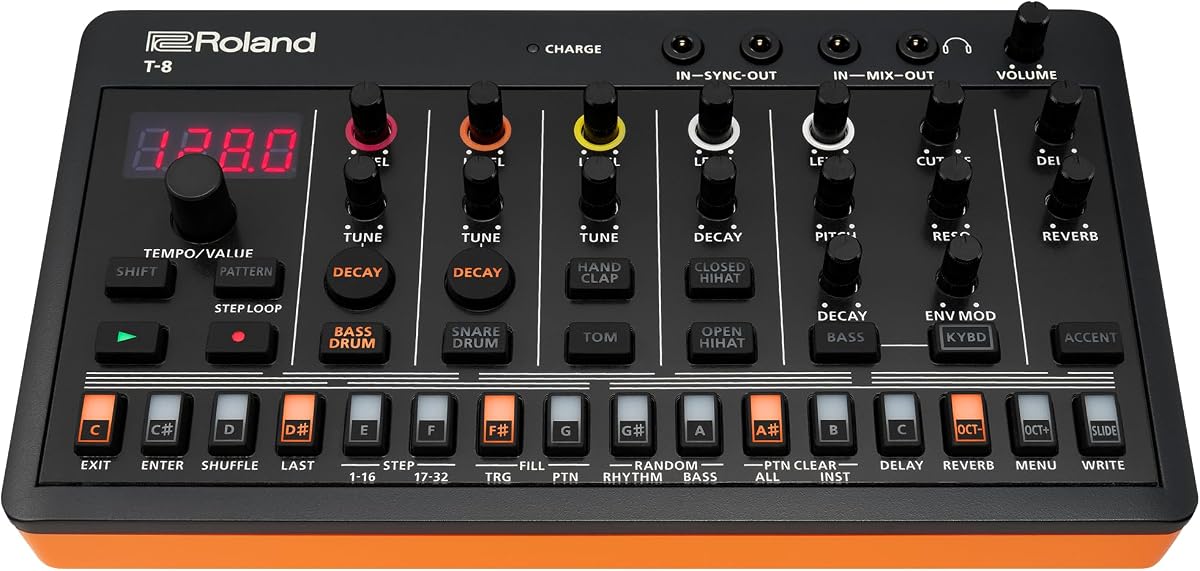
The AIRA Compact T-8 brings legendary Roland magic into the palm of your hand. With a 4.5 rating, it creates infectious tracks in seconds using pristine TR-808, TR-909, and TR-606 sounds. Its miniature design hides immense power for jamming and idea development anywhere.
We may earn a commission when you buy through this link, at no additional cost to you.
Analog Circuit Behavior Technology faithfully recreates the tonality of vintage instruments. The intuitive 16 step sequencer allows on-the-fly acid jams or trap bangers. Advanced rhythm programming includes probability and sub steps. Built-in effects like delay and sidechain compression enhance tracks. It connects seamlessly via USB-C audio and MIDI interface.
Pattern storage is limited and battery power is absent, which limits standalone mobile sessions. However, the workflow for quick sketches and live performances remains excellent. The trade-off favors size and integration over complex sequencing depth.
Mobile creators and live performers needing a portable beat maker will love its immediacy. The combination of classic sounds, effects, and compact form makes it perfect for spontaneous creativity and on-stage use.
ACB technology ensures the beats hit with the authentic punch and texture of the original hardware classics.
Real-time recording and step looping allow for expressive live manipulation without stopping the flow of music.
We may earn a commission when you buy through this link, at no additional cost to you.
The Behringer RD-9 provides a direct route to analog drum synthesis with modern enhancements. With a 4.5 rating, it focuses on core analog sounds complemented by a filter and wave designer. It is a straightforward tool for those who want raw tone shaping.
We may earn a commission when you buy through this link, at no additional cost to you.
Its analog filter and wave designer effects allow unique timbres. 11 drum sounds cover essential roles. The 10 individual outputs enable detailed routing. MIDI in, out, and thru allow integration with other hardware. 3 trigger outputs offer control over external gear. This hardware-focused approach simplifies the workflow.
It lacks deep sequencing capabilities and extensive sound variations compared to hybrid units. This makes it less flexible for complex electronic production. However, its simplicity is a strength for those prioritizing immediate sound manipulation over programming.
Hardware-focused producers and analog purists will find this unit satisfying. The dedicated controls and outputs make it ideal for live sound design and modular studio setups where direct connection matters.
Dedicated knobs for filter and effects allow real-time modulation that adds movement to static drum loops.
Multiple trigger outputs and MIDI ports let you synchronize and control external synthesizers and sequencers effortlessly.
We may earn a commission when you buy through this link, at no additional cost to you.
The Roland TR-1000 is the most powerful drum machine Roland has ever created. With a perfect 5.0 rating, it combines a newly developed analog engine with an ACB modeling engine and over 2000 onboard sounds. It is built for professionals who demand total sonic control.
We may earn a commission when you buy through this link, at no additional cost to you.
Its analog engine offers classic TR-808 and TR-909 sounds with extended range and new parameters. The sampler supports stereo resampling and 46GB memory. Next-generation TR-REC sequencer offers off-grid control and motion recording. Stereo analog effects include SVF and Roland classics. Expansive audio I/O handles complex studio setups.
The high price and complex feature set may overwhelm casual users. These factors are acceptable for professionals seeking top-tier reliability and sound quality. The investment pays off in creative flexibility and sonic depth unavailable elsewhere.
Professional producers and serious studios will find this unit unmatched. Its combination of analog warmth, digital sampling, and robust construction makes it a centerpiece capable of handling any genre or production demand.
With over 2000 onboard sounds and advanced sampling, you have limitless options for crafting unique rhythms.
Expansive I/O and USB-C audio interface ensure seamless connection with any modern studio configuration.
We may earn a commission when you buy through this link, at no additional cost to you.
The Behringer LM Hybrid Drum Machine combines analog warmth with modern sampling capabilities. With a 4.4 rating, it offers a 109 sound library and 64-step sequencer for versatile beat making. The hybrid approach supports both classic and contemporary production styles.
We may earn a commission when you buy through this link, at no additional cost to you.
Hybrid sampling allows custom audio integration alongside preset sounds. The sequencer supports complex rhythmic programming. Dual-mode filter and Wave Designer effects add unique texture. This flexibility bridges the gap between analog purists and digital producers.
Documentation is limited and build quality is average compared to premium units. These factors are acceptable given the feature set and price. Users willing to explore will find significant creative potential in its hybrid architecture.
Producers seeking a balance of analog feel and digital flexibility will appreciate this model. It provides a versatile platform for experimental beat making without requiring complex external software or hardware.
Combining samples with analog synthesis provides a broad palette of sounds for modern electronic music production.
Wave Designer and dual filters allow unique sound sculpting that distinguishes your tracks from standard presets.
We may earn a commission when you buy through this link, at no additional cost to you.
The Behringer BMX Hybrid Sampling Drum Machine focuses on hands-on sample manipulation with 24 pads. With a 2.0 rating, it offers 8 voice hybrid sampling and sample recording. However, user satisfaction is currently lower than other models due to software stability.
We may earn a commission when you buy through this link, at no additional cost to you.
Its 24 pads provide detailed control over samples and performance. The 64 step sequencer supports complex arrangements. Dual-mode filter and Wave Designer add sound shaping. Sample recording allows direct audio capture for custom kits. This hardware approach targets live performance.
Software stability issues and low satisfaction ratings indicate potential risks. These factors are significant drawbacks for reliable workflow. Buyers should consider support resources before committing due to potential technical challenges.
Experimental producers willing to troubleshoot may still find its performance features valuable. The extensive pads and sampling capabilities support creative workflows despite current software limitations.
24 pads allow layered triggering and performance manipulation that mimics live drumming techniques.
Direct recording capability lets you capture unique sounds from your environment for immediate use in kits.
We may earn a commission when you buy through this link, at no additional cost to you.
The Behringer LmDrum Hybrid Sampling Drum Machine offers a massive 109 sound library for diverse production. With a 5.0 rating, it provides robust hybrid capabilities and dual-mode filtering. This unit supports extensive sonic exploration for producers needing variety.
We may earn a commission when you buy through this link, at no additional cost to you.
Its 109 sound library covers extensive genres and styles. The 64 step sequencer ensures complex patterns. Wave Designer allows deep sound shaping. Dual-mode filter offers tone variation. Hybrid architecture supports both samples and analog synthesis. It is designed for versatility.
Average build quality and limited external sync are minor compromises. These are acceptable given the sound options and internal flexibility. Users prioritizing sound variety will find the limitations negligible compared to the library breadth.
Producers seeking a wide array of sounds without external plugins will benefit most. It serves as a standalone powerhouse for those who value internal sound diversity and hybrid flexibility in one box.
With 109 sounds included, you have immediate access to a broad range of tones without loading extra files.
The hybrid nature allows blending of samples and analog tones for unique textures that stand out in mixes.
We may earn a commission when you buy through this link, at no additional cost to you.
The Akai Professional MPC XL Standalone is a complete music production powerhouse requiring no computer. With a 4.9 rating, it features a Gen 2 8-core processor, 16GB RAM, and 256GB internal SSD. It supports running multiple plugins simultaneously for full production workflows.
We may earn a commission when you buy through this link, at no additional cost to you.
Its 16 expressive pads feature 3D-sensing technology for morphing and layering. The 10.1-inch HD touchscreen offers intuitive control. 16-step performance sequencer allows precise pattern building. Studio-grade performance supports up to 32 plugin instruments and 16 audio tracks. USB-C audio interface ensures connectivity.
High cost and large footprint are significant trade-offs for smaller studios. However, the comprehensive feature set justifies the investment for professionals. The convenience of standalone production makes it valuable for serious producers needing reliability and power.
Beat makers and independent producers who want a complete studio in one unit will find this ideal. Its robust performance and expressive controls deliver professional results without relying on external computers or software.
With all plugins and audio tracks running locally, you can produce entire songs without needing a separate computer.
3D-sensing pads allow nuanced performance control that enhances live shows and detailed sound design sessions.
We may earn a commission when you buy through this link, at no additional cost to you.
Choosing the right drum machine depends on your specific workflow needs, budget, and desired sound characteristics. This guide outlines the key factors to consider.
Decide between analog circuit modeling and digital sampling based on your sound goals. Analog models like the TR-08 replicate vintage warmth while hybrid options offer broader flexibility.
Analog circuits provide authentic texture; digital or hybrid offers variety. Choose what matches your sonic aesthetic.
Look for step sequencer depth, sub-step timing, and real-time recording features. Complex patterns need advanced sequencers like the TR-1000 or TR-6S for precision and variety.
Advanced sequencing allows intricate rhythms. Ensure the model supports the complexity you need.
Consider battery power and physical size if you plan to produce outside the studio. Units like the TR-6S and T-8 offer mobile-friendly designs unlike desktop-only models.
Battery power ensures true mobility. If you travel, pick a unit with battery support.
Check MIDI, USB, and audio outputs to ensure compatibility with your existing gear. Some models act as audio interfaces for easy DAW integration without extra hardware.
Strong connectivity simplifies workflow. Choose one that connects directly to your computer or mixer.
Support for custom samples and external storage allows for unique sound design. Higher-end models include extensive memory for loading your own audio files for kits.
Sample support enables unique sounds. Ensure memory and format support align with your needs.
Robust chassis and durable components ensure reliability during live performances or heavy studio use. Metal builds like the TR-1000 offer longevity compared to plastic alternatives.
Solid construction reduces repair needs. Prioritize models with durable materials if you travel.
Prices range from affordable analog options to expensive all-in-one production centers. Determine how much you can spend before evaluating features to avoid overspending.
Set a budget early. Balance cost against essential features for your production goals.
Intuitive controls and tactile feedback speed up workflow. Physical knobs for sound shaping are preferred over menu-driven interfaces for live manipulation.
Physical controls improve speed. Avoid interfaces that require deep menu diving.
Begin by powering on the unit and connecting it to your audio interface via MIDI or USB. Install any required drivers if necessary and ensure your software recognizes the device correctly.
Use the step sequencer to build patterns by pressing step buttons and selecting sounds for each position. Adjust sound parameters like decay and tuning to match your track's vibe.
Store your patterns in internal memory or export them via USB regularly. Keep the device in a dry and cool environment to protect circuitry. Avoid direct sunlight to prevent display damage.
Many standalone models like the Roland TR-1000 or Akai MPC XL operate fully without a computer. They include internal storage and audio interfaces allowing you to record and play directly.
Analog machines use circuit modeling to create sounds while hybrids combine analog synthesis with digital sampling. Hybrids offer broader sound libraries whereas analog provides unique warmth.
You can use any standard DAW via USB or MIDI if the unit supports it. Some models act as audio interfaces allowing direct recording without extra software.
Yes many models like the TR-1000 and Behringer hybrids support custom sample loading. You typically transfer files via USB or SD card and assign them to pads.
Models with physical pads like the Akai MPC XL or TR-6S are ideal for live use. They offer immediate control and portable designs suited for stage.
Use individual audio outputs to send drum tracks to external pedals or processors. Some units feature dedicated FX loops for built-in effects processing.
The Roland TR-1000, Behringer RD-8, and Akai MPC XL represent the top picks across performance, value, and power categories respectively. Each delivers distinct strengths suited to specific production styles.
Prioritize sound engine type and sequencing depth if you work heavily with electronic genres. Portability matters if you travel while connectivity is vital for integrated studio setups.
Always check current pricing and availability as retailers update stock regularly. Your ideal model depends on balancing these features against your budget and workflow.