
6-Band Signal Generator
100KHz to 150MHz range
Low phase noise performance
Simple assembly-free operation
This guide compares the top Amfm Signal Generator models for 2026, evaluating performance, features, and value to help you choose the right tool for your needs.
Finding the right Amfm Signal Generator is crucial for electronics testing and development. Whether you are a hobbyist or a professional engineer, having a reliable source for precise waveforms ensures accurate results in your projects.
We evaluated ten leading models based on frequency range, modulation capabilities, and ease of use. Our analysis focuses on how each device handles AM and FM signals to support diverse testing scenarios effectively and efficiently.
Each pick highlights key strengths and potential limitations to guide your decision. Prices and availability may change, so verify current details before purchasing to ensure you get the best value for your specific application requirements.

5.0Editor score

5.0Editor score
This side-by-side comparison outlines the core specifications and capabilities of each model to help you identify the best fit for your technical requirements and budget constraints quickly.




The UNI-T UTG962E is a standout Amfm Signal Generator offering high performance in a compact form. It boasts a 60 MHz frequency range and dual channels for versatile testing needs.
We may earn a commission when you buy through this link, at no additional cost to you.
Its modulation capabilities include AM, FM, and PM, allowing detailed signal analysis. The unit also supports arbitrary waveforms with a high sample rate for precise output.
While memory depth is somewhat limited compared to larger benchtop units, the portability makes it ideal for field work. The interface is straightforward for quick configuration.
This generator is perfect for enthusiasts and professionals needing reliable AM and FM signal sources. Its balance of features and size makes it the top choice in this review.
The device supports AM, FM, PM, and FSK modulation types ensuring comprehensive testing capabilities for various electronic applications.
Its mini palm-sized footprint allows easy transport to lab or field sites without compromising on core waveform generation performance.
We may earn a commission when you buy through this link, at no additional cost to you.
The OWON DGE2035 provides a robust platform for dual-channel arbitrary waveform generation. It features a 35 MHz output and high resolution for stable signal performance in labs.
We may earn a commission when you buy through this link, at no additional cost to you.
With over 150 built-in arbitrary waveforms and a clear TFT screen, this unit is user-friendly for educational and research applications. PC control adds remote operation flexibility.
The menu system can be slightly complex for new users, and the frequency limit may not suit high RF needs. However, its portability and display quality are strong points.
Ideal for students and engineers needing dual-channel outputs without a large benchtop footprint. It offers a good balance of features for general waveform testing tasks.
The 3.6-inch TFT LCD offers real-time waveform visualization making setup and adjustments intuitive during complex testing procedures.
Supports remote control and has a wide waveform library ideal for training environments and research testing requiring detailed signal analysis.
We may earn a commission when you buy through this link, at no additional cost to you.
This 6-Band Signal Generator delivers impressive value with a wide frequency range from 100KHz to 150MHz. It supports AM and FM modulation effectively for radio testing needs.
We may earn a commission when you buy through this link, at no additional cost to you.
The device features low phase noise for signal purity and a sturdy metal build for durability. Its design allows for quick setup without assembly requirements saving valuable time.
While it lacks advanced digital features found in higher-end models, it performs reliably for maintenance and basic testing. The simplicity is a plus for users needing straightforward operation.
A great entry-level option for hobbyists or maintenance technicians. It covers essential needs for RF signal generation without the cost of complex equipment.
Low phase noise characteristics ensure signal quality is maintained reducing interference during testing in sensitive environments.
High-class metal construction provides resistance to scratches and impacts extending the service life of the generator for heavy use.
We may earn a commission when you buy through this link, at no additional cost to you.
The Upgraded RF Signal Generator extends frequency coverage up to 4400MHz making it suitable for varied high-bandwidth applications. It offers both single and sweep modes for flexibility.
We may earn a commission when you buy through this link, at no additional cost to you.
Power-off memory ensures settings are saved for quick resumption. USB power connectivity allows easy integration with modern setups without bulky adapters.
Some users report minor noise in the sine wave output which may affect precision sensitive tasks. The price reflects the high range but consider your specific needs.
This unit fits specialized needs for RF testing beyond standard bands. Its sweep mode and memory features add value for professionals working with wide frequency spectra.
Supports outputs from 35MHz to 4400MHz covering extensive RF applications not found in standard generators.
Retains settings when power is cut and uses USB power banks for mobile testing convenience in remote locations.
We may earn a commission when you buy through this link, at no additional cost to you.
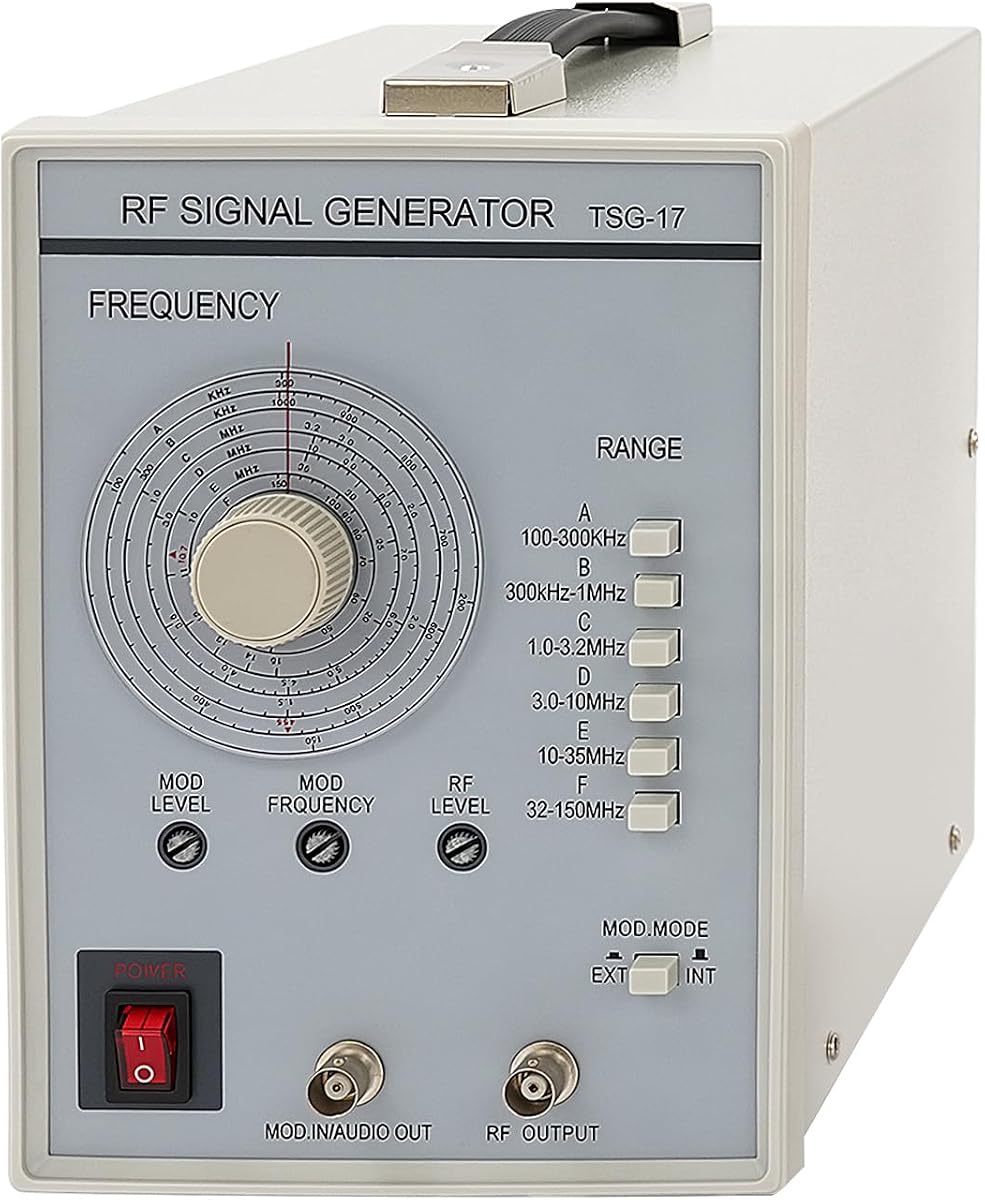
The TSG-17 provides a high accuracy RF and AM signal source covering 100kHz to 150MHz. It includes harmonic outputs up to 450MHz for broader testing options.
We may earn a commission when you buy through this link, at no additional cost to you.
External modulation inputs allow for flexible signal manipulation while a standard 110V cord ensures stable power. The output control is precise for various applications.
The interface is basic compared to modern digital units which may slow workflow. Resolution is limited but adequate for commercial and household maintenance tasks.
Suitable for traditional labs requiring steady analog signal sources. Its reliability in RF output makes it a practical choice for routine calibration work.
Allows external signals to modulate the output between 50Hz to 20 KHz providing flexibility for complex test scenarios.
Produces harmonic signals up to 450MHz extending utility beyond the base frequency range for diverse testing needs.
We may earn a commission when you buy through this link, at no additional cost to you.
This generator targets industrial testing with adjustable current and voltage outputs. It supports 4-20mA and 0-12V ranges with high accuracy after calibration.
We may earn a commission when you buy through this link, at no additional cost to you.
The built-in lithium battery allows portable field use and charging protection ensures safety. PWM output adds frequency flexibility for specific control systems.
Charging can take over six hours which may limit rapid deployment. The focus is on analog signals rather than RF waveforms for electronics testing.
An excellent tool for PLC and sensor testing requiring precise current loops. Its battery option enhances portability for maintenance teams in the field.
Provides settable 0-24mA and 0-12V outputs suitable for calibrating industrial sensors and control loops accurately.
Integrated battery allows untethered operation for hours making it ideal for remote equipment debugging without power sources.
We may earn a commission when you buy through this link, at no additional cost to you.
The Riiai generator combines voltage and current outputs in a compact form. It features 4-digit displays for clear reading and multiple power modes for flexibility.
We may earn a commission when you buy through this link, at no additional cost to you.
Users can switch between 0-10V and 4-20mA easily. Built-in battery and external power options ensure it works in various environments without interruption.
The output range is standard for process control but not for RF needs. Safety features like short circuit protection protect devices during testing.
Perfect for PLC panel debugging and device testing. Its size and ease of use make it a convenient addition to any technical toolkit.
Switchable voltage and current modes allow testing both types of signals with one device saving space and cost.
Includes short circuit and reverse connection protection ensuring safe operation during routine maintenance and setup tasks.
We may earn a commission when you buy through this link, at no additional cost to you.
This model offers advanced simulation with multiple signal types including current voltage and pulse. A 2.4-inch color screen displays curves for better visualization.
We may earn a commission when you buy through this link, at no additional cost to you.
Preset values and programmable output modes simplify complex testing. The 3000mAh battery supports extended operation up to 26 hours for uninterrupted work.
The interface is feature-rich which may require time to master. It is ideal for industrial PLC testing where detailed signal simulation is required.
A top choice for professionals needing versatile analog and pulse simulation. The large screen and battery life add significant value for field use.
Supports conversion between different signal types allowing one unit to replace multiple tools for complex testing needs.
Auto rise drop and cycle modes automate signal changes reducing manual effort during repetitive testing scenarios.
We may earn a commission when you buy through this link, at no additional cost to you.
The DROK generator provides basic ampere and voltage signals in a simple module. It uses a multi-cycle potentiometer for smooth adjustments of current and voltage.
We may earn a commission when you buy through this link, at no additional cost to you.
Its design is handy for quick tests without complex menus. It is effective for LED and panel testing where precise manual control is sufficient.
Lacking digital display limits precision but ensures ease of use. It serves well for basic troubleshooting tasks where speed and simplicity matter most.
Great for hobbyists needing a straightforward solution for signal simulation. Its compact size and low cost make it a practical addition to the bench.
Uses a single potentiometer to adjust outputs reducing the number of controls needed for quick setup and operation.
Offers a dual signal module at a low price point ideal for users needing basic functionality without advanced digital features.
We may earn a commission when you buy through this link, at no additional cost to you.
The SEESII Dual Channel generator delivers high precision DDS signals with independent dual outputs. It features 60 built-in arbitrary waveforms and a TFT LCD display.
We may earn a commission when you buy through this link, at no additional cost to you.
This model combines seven instruments in one saving desktop space. The channels allow independent parameter adjustments for complex differential testing scenarios.
The frequency is limited to 30MHz which may not suit RF specialists. However for general electronic design and R&D it offers unmatched versatility and precision.
Best for R&D engineers and university labs needing a complete signal tool. Its comprehensive features and accuracy justify the investment for professional use.
Two fully independent channels allow different waveform outputs simultaneously enabling advanced differential circuit testing.
Integrates frequency meter counter and sweeper functions reducing the need for multiple devices in the lab setup.
We may earn a commission when you buy through this link, at no additional cost to you.
Selecting the right generator requires understanding key technical parameters and usage scenarios to ensure it meets your specific testing demands.
The frequency range defines the bandwidth of signals you can generate. For RF testing, ensure the device covers your target frequencies including harmonics for accurate simulation.
Support for AM FM and PM modulation is essential for communication system testing. Look for units with FSK support if digital signals are required for your projects.
Dual channel models allow simultaneous output of two different signals. This is critical for differential circuit testing and advanced lab applications needing independent control.
A clear display like TFT LCD helps visualize waveforms and settings. Interfaces with shortcut keys reduce setup time allowing faster transitions between test configurations.
Portable units with battery support are vital for field work. Check for lightweight designs and USB power options if you plan to move between locations regularly.
High resolution and low distortion are key for precise calibration. Look for specs like 14-bit resolution to ensure signal purity in sensitive electronic testing environments.
Connect the generator to your device using appropriate BNC or coaxial cables to ensure stable signal transfer without interference from external sources.
Set the desired frequency and amplitude on the display while monitoring output to verify signal purity before starting formal testing procedures.
Store the unit in a dry place and avoid extreme temperatures to preserve battery life and internal components for consistent performance over time.
An Amfm Signal Generator produces radio frequency signals with amplitude and frequency modulation for testing radios and communication devices. It helps verify performance by simulating real-world signals in labs.
Choose handheld models for portability and field work where mobility is key. Benchtop models suit stationary labs requiring higher power and more features for detailed analysis.
Yes some specialized generators output current and voltage signals like 4-20mA which are standard for industrial PLC testing. Ensure the device supports these analog ranges before purchasing.
USB connectivity enables PC control and data logging which is vital for remote operations. It also allows for firmware updates to keep your generator current with new standards.
Phase noise measures signal purity by indicating unwanted frequency variations. Lower phase noise ensures cleaner signals which is critical for sensitive RF testing and receiver calibration.
Basic testing often requires only standard waveforms like sine and square. Arbitrary waveforms are useful for complex simulations but may not be necessary for simple maintenance tasks.
The UNI-T UTG962E, 6-Band Signal Generator, and SEESII Dual Channel stand out as top picks for varied needs and budgets across different testing environments.
Prioritize frequency range and modulation types to ensure your generator supports the specific signals required for your projects and professional standards.
Prices and stock fluctuate so always check the latest product pages for current offers before finalizing your purchase to secure the best value available.