
Acxico 3Pcs Mini Micro N20
4.6Editor score
Full metal gearbox design
3V to 6V operation
Compact 3mm D-type shaft
This guide compares the top DC motors for robots available in October 2026. We evaluate torque, voltage, gear ratios, and build quality to help you choose the
Choosing the right DC motors for robots is critical for building reliable and efficient robotic systems. Whether you are constructing a simple line follower or a complex robotic arm, the motor you select dictates movement precision, torque output, and overall durability. Understanding the nuances of gearboxes, shaft types, and voltage requirements ensures your robot performs as expected.
We analyzed ten highly rated DC motor kits and units to create this comprehensive comparison. Our evaluation focused on real-world performance metrics such as stall torque, no-load speed, gear reduction ratios, and build materials like metal versus plastic gears. We also considered ease of integration with common microcontrollers like Arduino and Raspberry Pi for DIY enthusiasts.
Each pick in this list highlights specific strengths and ideal use cases for different robotic applications. You will find options ranging from micro N20 gear motors for compact wheeled robots to high torque planetary motors for heavy lifting tasks. Please note that product availability and pricing can fluctuate, so verify details before purchasing to ensure compatibility with your project requirements.
4.6Editor score

4.7Editor score

4.6Editor score
The following table provides a side-by-side comparison of all ten selected DC motors for robots. It highlights key specifications including voltage ranges, gear ratios, torque ratings, and shaft types to help you quickly identify the best fit for your robotic design requirements.



This motor set stands out as our top recommendation for builders needing precise motion control in robotic projects. With a high rating of 4.7 stars it combines robust all-metal gearboxes with integrated encoders to provide accurate speed and position feedback. The 1:90 gear ratio ensures enough torque for heavy loads while maintaining smooth operation across a wide voltage range.
We may earn a commission when you buy through this link, at no additional cost to you.
The key strength lies in its upgrade to all-metal gearing which significantly improves durability compared to plastic alternatives often found in similar kits. The Hall encoder outputs two 90-degree quadrature waves allowing for closed-loop control essential for advanced applications like self-balancing robots or automated guided vehicles. Additionally the dedicated anti-reverse connection interface simplifies wiring and ensures secure power delivery.
While the price is higher than basic motor sets the inclusion of encoders and metal components justifies the investment for serious hobbyists. The only minor trade-off is the need for extra wiring to connect the encoder to your microcontroller which may complicate very simple projects. However this trade-off is acceptable given the level of control and reliability you gain in return.
We recommend this motor set for anyone building smart cars robotics platforms or automation projects where precise motion feedback is critical. It is particularly suitable for users working with Arduino or similar boards who want to implement PID control or odometer tracking without buying separate encoders. For projects requiring long-term reliability and high torque this is the best choice available today.
The integrated 12PPR Hall encoder allows your robot to measure wheel rotation accurately enabling better navigation and stability.
Upgraded metal gears and shafts provide superior strength for heavy-duty tasks and ensure a longer service life under load.
We may earn a commission when you buy through this link, at no additional cost to you.
The Acxico 3Pcs Mini Micro N20 Gear Motor set offers excellent value for builders working on compact wheeled robots. Rated highly for its full metal gearbox design this kit provides reliable performance at an accessible price point making it ideal for education or prototype projects. The motors operate efficiently between 3V and 6V which aligns well with standard battery packs and USB power sources.
We may earn a commission when you buy through this link, at no additional cost to you.
Its standout quality is the full metal gearbox which reduces wear and tear compared to plastic gear systems often found in budget kits. The 3mm D-type shaft ensures secure attachment of wheels or pulleys reducing slippage during operation. This reliability is crucial for maintaining consistent speed and direction in line-following or obstacle-avoidance robots commonly built by students and hobbyists.
The main trade-off is the lack of integrated encoders meaning speed control relies on voltage adjustments rather than feedback loops. Additionally torque output is modest compared to larger geared motors so it is not suited for lifting heavy payloads. These limitations are acceptable for the price and target use case of small lightweight robots where precision is secondary to cost.
This motor set is perfect for DIY robot car projects or educational kits where budget is a primary constraint. We recommend it for beginners learning about basic DC motor principles or for creating multiple identical units for swarm robotics experiments. If you need a dependable low-cost solution for small robots this is a strong candidate.
Buying three motors together lowers the cost per unit which is ideal for building multi-wheeled vehicles or robot swarms.
The metal gearbox ensures smoother operation and longer life than plastic gears especially under continuous use conditions.
We may earn a commission when you buy through this link, at no additional cost to you.
For projects requiring significant pulling or lifting power this DC planet gear motor delivers exceptional performance with a massive 90kg.cm torque rating. Its ability to operate across a 6V to 22V range makes it highly versatile for different battery configurations and power supplies. The metal planetary gear system ensures high efficiency and durability which is essential for demanding applications like rotating tables or automated locks.
We may earn a commission when you buy through this link, at no additional cost to you.
The key strength is its robust high torque design capable of moving heavy payloads that smaller motors cannot handle. The D-shaft diameter of 8mm provides a strong mechanical interface for couplers or gears reducing flex under load. Users can also change the motor rotation direction by adjusting the wiring connection offering flexibility for bidirectional tasks without complex controllers.
The trade-off is its larger size and higher power needs which may complicate compact designs or require more substantial battery packs. It is also less suitable for delicate precision tasks where lower torque is preferred to avoid damage. However for heavy-duty robotics or automation where strength is paramount these trade-offs are justified by the performance gains.
We recommend this motor for industrial-style DIY projects heavy lifting robots or large rotating structures. It is ideal for users who need reliable high-torque power and have the mechanical space to accommodate its dimensions. If your project demands strength and versatility this motor is a top-tier choice for performance.
Supporting 6V to 22V allows integration with various battery types from standard 12V to higher voltage lithium packs.
Planetary gearing distributes load across multiple teeth providing greater torque and longevity than spur gears.
We may earn a commission when you buy through this link, at no additional cost to you.
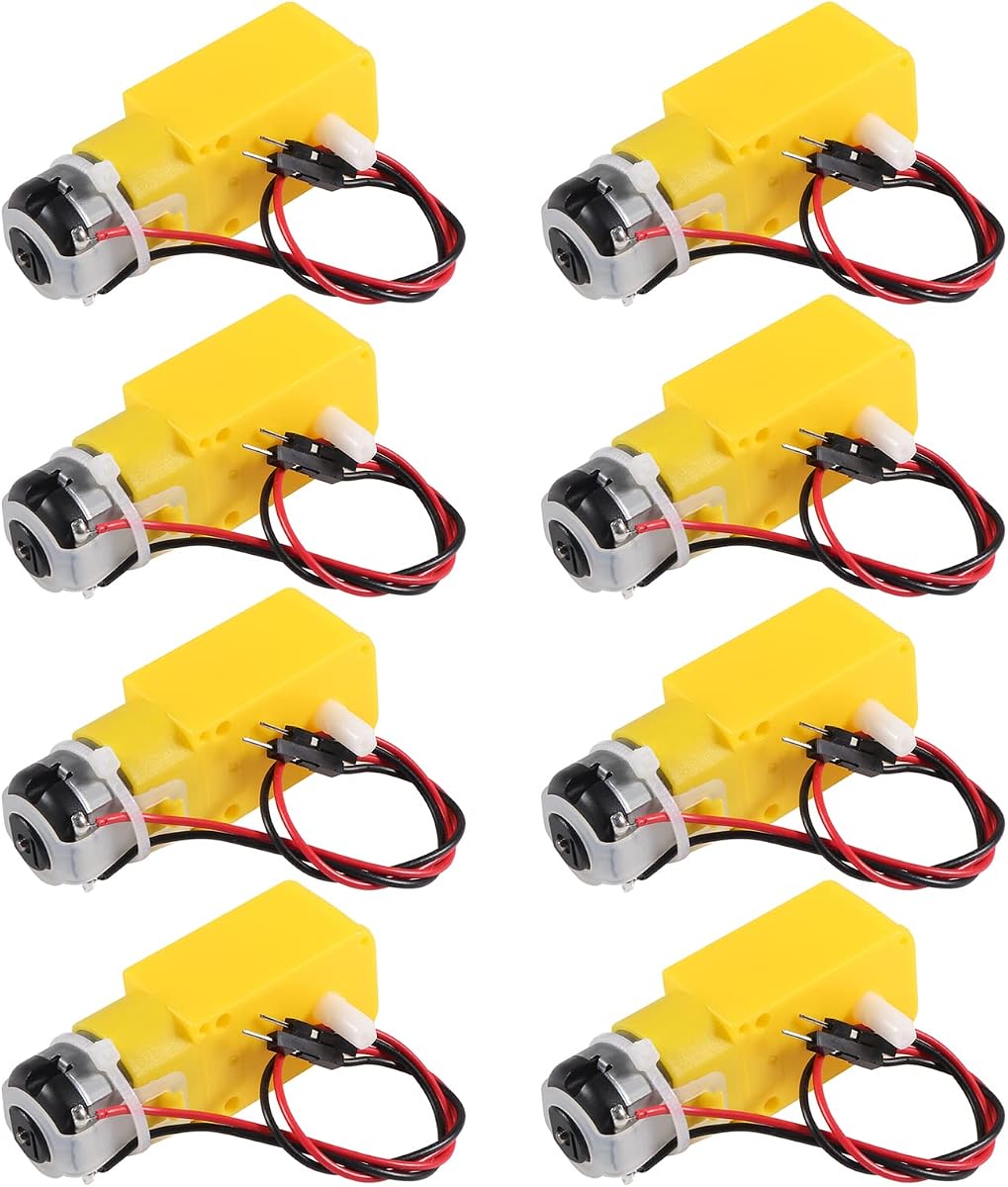
This kit offers exceptional value by including eight TT motors along with four wheels making it ideal for schools or group projects. Operating at 3 to 6V it provides a steady 200RPM output suitable for moderate speed robot cars. The pre-wired 2.54mm connectors simplify integration with breadboards or terminal blocks reducing assembly time significantly.
We may earn a commission when you buy through this link, at no additional cost to you.
The key strength is the bulk quantity which allows teams to build multiple identical robots without ordering separately. The motor set uses premium environment-friendly materials designed for durability and long service life. Its 1:48 gear ratio balances speed and torque well for educational smart car competitions or distance measurement tasks where precision is needed.
The trade-off is the use of plastic gears which may wear faster under heavy loads compared to metal alternatives. Torque is limited to 0.8kg.cm at 6V which restricts use to lighter robots. These limitations are acceptable for the price and intended educational use where robots are not subjected to extreme stress.
We recommend this set for classroom activities robotics competitions or hobbyists needing multiple units. It is perfect for building smart cars or small robots where cost and convenience are priorities. If you need many motors quickly for group projects this is a highly practical choice.
Including wheels and connectors saves time and money making setup faster for large scale deployments.
The 2.54mm male connectors fit standard headers allowing easy plug and play with microcontrollers.
We may earn a commission when you buy through this link, at no additional cost to you.
This motor is designed specifically for 12V systems making it a seamless fit for projects using standard lead acid or lithium battery packs. It delivers 500 RPM with a full metal gear reduction ensuring durability and consistent performance. The inclusion of a rubber tire wheel kit and mounting bracket simplifies assembly and ensures immediate readiness for testing.
We may earn a commission when you buy through this link, at no additional cost to you.
Its standout quality is the use of pure copper coils which improve conductivity and reduce heat generation. The high-precision rotor material and full metal gears contribute to long life and quiet operation essential for robots moving in indoor environments. The encoder provides additional feedback capability allowing for better speed control in automated tasks.
The limitation is that it operates primarily at 12V which limits flexibility if your project uses lower voltage logic or power. It is also fixed in configuration compared to motors with adjustable wiring for direction reversal. For 12V systems these constraints are acceptable given the robust build and convenience features included.
We recommend this motor for smart car models or robot kits designed around 12V architecture. It is ideal for users wanting an all-in-one solution with wheels and brackets included. If your system supports 12V and values durability this motor is a strong performer.
Included brackets and wheels mean you can mount the motor and test movement immediately without extra purchases.
Pure copper coils and high-quality materials reduce heat and resistance improving longevity and performance stability.
We may earn a commission when you buy through this link, at no additional cost to you.
This motor offers flexibility by supporting both 6V and 12V inputs allowing you to adapt to different battery setups. With a 70:1 gear ratio it provides substantial torque suitable for smart balance cars or measuring devices. The included metal mounting bracket facilitates easy installation and secure attachment to robot chassis designs.
We may earn a commission when you buy through this link, at no additional cost to you.
Its strength is the high stall torque reaching 27 kg.cm at 12V which enables moving heavier components smoothly. The metal gearing ensures longevity under continuous operation which is vital for projects requiring frequent start-stop cycles. The 6mm D-shaped shaft prevents wheel slip providing reliable mechanical coupling for wheels or gears.
The trade-off is moderate no-load speed which limits use to low to medium speed applications. It is also slightly heavier than some alternatives which may impact balance in lightweight robots. For applications prioritizing torque and flexibility these characteristics are acceptable and often preferred.
We recommend this motor for smart balance cars or DIY engine toys where variable power is needed. It is suitable for builders needing reliable torque and easy mounting options. If your project requires 6V or 12V adaptability this is a solid choice.
Working at 6V or 12V allows adaptation to different battery types without needing additional voltage regulators.
The included metal bracket ensures stable attachment reducing vibration and misalignment during operation.
We may earn a commission when you buy through this link, at no additional cost to you.
This motor set is praised for its powerful yet quiet performance making it ideal for RC cars and DIY toys where noise matters. Operating between 6 and 12V it delivers 350 RPM with high torque ensuring responsive movement. The all-metal gears are heat and wear-resistant which ensures long-lasting strength even during demanding use.
We may earn a commission when you buy through this link, at no additional cost to you.
The standout feature is the efficient copper rotor which increases torque by 30 percent improving power delivery significantly. The double-shaft design offers flexibility to connect wheels or gears on both ends enabling custom mechanical arrangements. The 4mm steel shaft with flat side prevents slipping ensuring secure mechanical connections.
The limitation is the lack of encoders so speed feedback requires external sensors. It is also primarily targeted at 12V systems which may not suit low-voltage logic. For RC cars and quiet operation these trade-offs are acceptable given the performance gains.
We recommend this motor for RC car DIY and massage devices requiring reliable power. It is suitable for projects needing dual-sided shaft options. If quietness and torque are priorities this motor is an excellent choice.
All-metal gears and optimized structure reduce noise making it suitable for indoor toys and quiet robots.
Double-shaft design allows connecting components on both ends expanding mechanical flexibility for custom builds.
We may earn a commission when you buy through this link, at no additional cost to you.
These miniature motors deliver high speed with a 16000 RPM rating at 3V making them ideal for fans or light wheels. Operating from 1.5V to 6V they offer flexibility for battery-powered and solar projects. Each unit comes with 6 inch wire leads for easy connection to circuits without soldering.
We may earn a commission when you buy through this link, at no additional cost to you.
The key strength is speed which suits applications requiring rapid rotation rather than torque. The compact size allows fitting into tight spaces for brush-bots or small fans. The pack of 6 provides good value for experiments or replacing multiple units simultaneously.
The limitation is low torque and plastic construction which limits heavy-load applications. It is best for lightweight robots or educational tasks. For high-speed tasks these trade-offs are acceptable.
We recommend this set for Arduino hobby projects and fans. It is suitable for experiments needing compact high-speed motors. If speed is your priority this is a good choice.
16000 RPM at 3V provides fast rotation ideal for spinning blades or light duty wheels.
15cm wire leads allow quick plug and play integration with breadboards or circuits.
We may earn a commission when you buy through this link, at no additional cost to you.
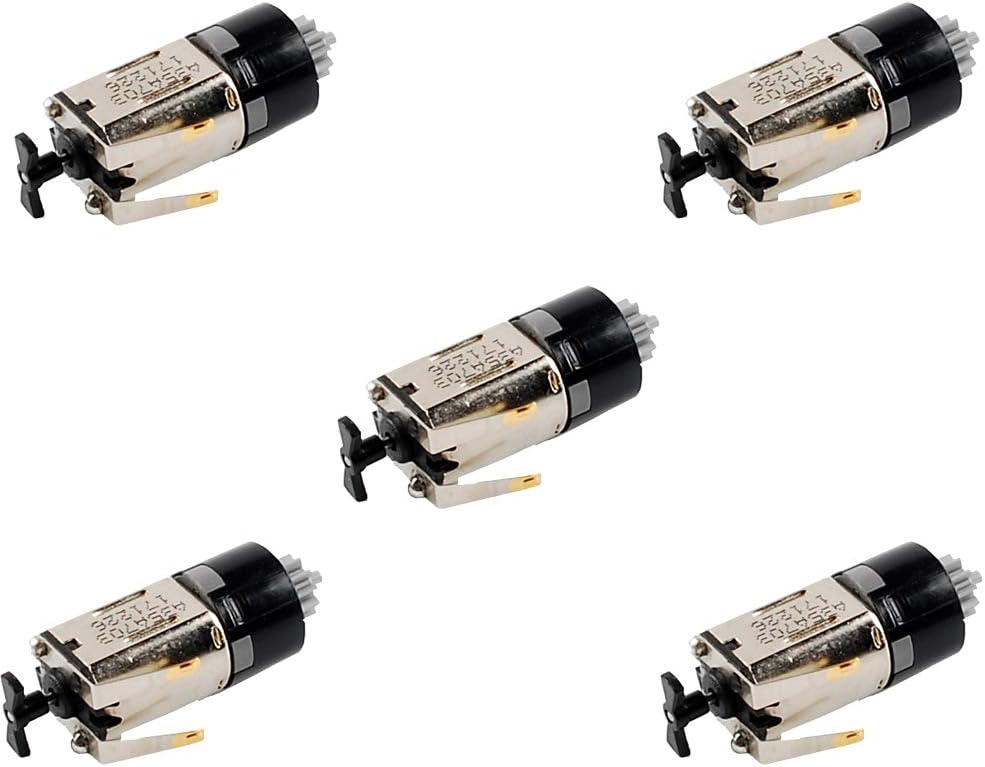
This motor uses a micro planetary reducer to achieve high torque at low speeds ideal for precise movements. Operating from 3V to 5V it draws low current ensuring efficiency. A pack of 5 units is provided for multi-unit projects or backups.
We may earn a commission when you buy through this link, at no additional cost to you.
The key strength is torque in a small form factor suitable for robotic grippers or slow wheels. The planetary design reduces noise and improves durability. Low speeds help maintain control in delicate tasks.
The limitation is very low RPM limiting speed. It is best for slow precise tasks. For micro torque this is acceptable.
We recommend this for DIY robot gearbox projects. It is suitable for slow torque-heavy tasks. If micro torque is needed this is a good choice.
Planetary design provides high torque in a tiny package perfect for tight robotic joints.
Low current consumption at 3V to 5V extends battery life in portable projects.
We may earn a commission when you buy through this link, at no additional cost to you.
This motor provides high speed with a 12000 RPM output suitable for RC cars and power wheels. Operating from 6 to 12V it is compatible with common batteries. Its low noise design is suitable for indoor toys and models.
We may earn a commission when you buy through this link, at no additional cost to you.
The key strength is speed and compatibility with Traxxas vehicles making it a practical replacement or upgrade. The 2.3mm shaft fits standard gears and pulleys easily. Compact size allows for fitting into small housings.
The limitation is lack of gearbox meaning torque is lower than geared units. It is best for high-speed applications. For RC cars this is acceptable.
We recommend this for RC upgrades and science experiments. It is suitable for projects needing speed. If speed is priority this is a good choice.
Designed to replace motors in Power Wheels and Traxxas vehicles ensuring a direct fit.
Small footprint and quiet operation make it ideal for indoor RC and model projects.
We may earn a commission when you buy through this link, at no additional cost to you.
Selecting the right DC motor for robots depends on your project's specific torque, speed, and voltage requirements.
Ensure the motor voltage matches your battery or power supply. Most options operate between 3V and 12V but some support 6V to 22V. Mismatched voltage can cause overheating or poor performance.
Always verify voltage requirements before purchase to avoid compatibility issues.
Torque determines how much load the motor can move. Heavier robots require motors with higher stall torque like 1 kg.cm or more. Check stall torque specs to ensure your robot can carry its weight and payload.
Prioritize higher torque for lifting tasks and heavy chassis builds.
Metal gearboxes are more durable than plastic ones and withstand wear better. Planetary and gear-reduction motors offer higher torque at lower speeds. Consider the gear ratio to balance speed and power for your use case.
Choose metal gears for longevity and high-load applications.
Encoders allow precise speed and position tracking by measuring wheel rotation. This is essential for navigation and balanced robots. If you need closed-loop control select a motor with an integrated encoder.
Use encoder motors for projects requiring accurate motion control.
Shaft dimensions affect wheel attachment. D-shaped shafts prevent slippage better than round ones. Ensure the shaft diameter fits your wheels or pulleys to avoid mechanical failure.
Verify shaft specs match your mounting hardware for secure assembly.
Compact motors fit better in small robots but may offer less torque. Check dimensions and if a mounting bracket is included to simplify assembly.
Choose size based on your chassis constraints and mounting needs.
Efficient motors like those with copper coils reduce heat and extend battery life. Consider power draw especially for battery-powered robots to maximize run time.
Select efficient motors to minimize heat and maximize battery duration.
Buying multi-packs like 8 units can lower cost per motor for large projects. Balance quality and cost by comparing specs across available kits.
Multi-packs offer cost savings for bulk educational or group projects.
Connect the motor wires securely to your power source and driver circuit ensuring correct polarity. Use appropriate gear ratios to match your desired speed and torque output.
Test the motor at low voltage first to check rotation direction and mechanical stability before applying full load.
Regularly inspect gears and shafts for wear and ensure mounting brackets are tightened to avoid vibrations during operation.
Most robot motors operate between 3V and 12V but always check the specific motor's range. Using higher voltage may increase speed but also heat and wear. Match your motor voltage to your battery pack voltage for optimal performance and safety.
Encoder motors are necessary when you need precise speed or position control such as for navigation or balance. For simple line-following or toy robots they may not be required. Use encoders when accurate feedback is critical to your application.
Calculate torque by estimating the robot's weight and wheel radius. Motors with higher stall torque handle heavier loads better. Choose torque rating that exceeds your expected load by a margin for reliability.
Plastic gear motors are suitable for light-duty and educational projects but may wear quickly under heavy loads. Metal gear motors are recommended for durability in demanding tasks. Consider your project stress level when choosing gear material.
A D-shaped shaft has a flat side that prevents wheels or pulleys from slipping during rotation. This is important for maintaining consistent speed and direction. Ensure your wheels match the shaft type for secure attachment.
Select motors with all-metal gears and proper mounting to minimize vibration. Use lower gear ratios and proper lubrication where applicable. Noise reduction improves performance especially in indoor environments.
This guide highlights the top DC motors for robots ranging from budget-friendly options to high torque premium units. The 2Pack TT Motor with Encoder stands out for precision control while the Acxico Mini N20 offers the best budget value.
When choosing prioritize voltage compatibility torque requirements and whether encoders are needed for your application. Ensure the motor matches your project size and mounting options for seamless integration.
Remember to verify current availability and prices before purchase as they can fluctuate. With the right motor your robotic project will have reliable and efficient power for all your DIY tasks.